


Page 17 - The Dispatch August 2019
P. 17
TEXAS MILITARY DEPARTMENT


          ities at home. So far he believes that Soldiers have been  considerations just became another aspect of the overall
          mostly supportive of the program.                    concept.

          “At  this  point  there  are  generally  more  favorable  com-  “Providing support is no different between the two types
          ments than unfavorable,” said Cerniauskas. “The one uni-  of training periods. It’s better for us because of repetition,”
          versally liked aspect of the program was training in the  said Mendoza. “We just mimic the first period with a few
          field in April when it’s cool versus the heat of July for two  minor adjustments.”
          weeks.”
                                                               As the program continues to develop, Cerniauskas looks
          Spc. Curtis Flanging, Texas Army National Guard engineer,  forward to finishing out the second session ending in July
          echoed the results of the 176th’s program surveys.   to gather concrete data on the effect to readiness. He ac-
                                                               knowledges it will  take time to evaluate if  the program
          “It can get overwhelming having a two-week annual train-  achieves the desired impact on readiness but still believes
          ing, so breaking it up is good,” said Flanging. “Also, if some-  there is a way to expand the effect to the units the engi-
          thing didn’t go right at the first session, you have time to  neers support.
          fix it for the next session.”
                                                               “We need to do more multiple annual training sessions to
          One of the key considerations for the segmented annu-  determine how sustainable this model is. It depends also
          al training program is coordinating the logistical support  on unit mission, training area accessibility and other fac-
          needed  to  locate  training  sites,  equipment  and  support  tors,” said Cerniauskas.
          not once but twice.  According to Mendoza, the logistical


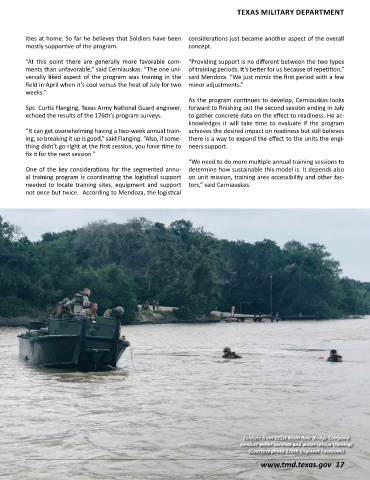
                                                                                  Soldiers from 551st Multi Role Bridge Company
                                                                                conduct water survival and water rescue training!
                                                                                   (Courtesy photo 176th Engineer Facebook)

                                                                                       www.tmd.texas.gov 17

