


Page 19 - The Dispatch September 2018
P. 19
TEXAS MILITARY DEPARTMENT
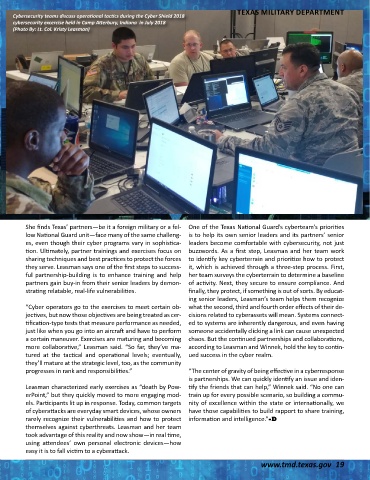
     Cybersecurity teams discuss operational tactics during the Cyber Shield 2018
     cybersecurity excercise held in Camp Atterbury, Indiana  in July 2018
     (Photo By: Lt. Col. Kristy Leasman)


          She finds Texas’ partners—be it a foreign military or a fel-  One of the Texas National Guard’s cyberteam’s priorities
          low National Guard unit—face many of the same challeng-  is to help its own senior leaders and its partners’ senior
          es, even though their cyber programs vary in sophistica-  leaders become comfortable with cybersecurity, not just
          tion. Ultimately, partner trainings and exercises focus on  buzzwords. As a first step, Leasman and her team work
          sharing techniques and best practices to protect the forces  to identify key cyberterrain and prioritize how to protect
          they serve. Leasman says one of the first steps to success-  it, which is achieved through a three-step process. First,
          ful  partnership-building  is  to  enhance  training  and  help  her team surveys the cyberterrain to determine a baseline
          partners gain buy-in from their senior leaders by demon-  of activity. Next, they secure to ensure compliance. And
          strating relatable, real-life vulnerabilities.       finally, they protect, if something is out of sorts. By educat-
                                                               ing senior leaders, Leasman’s team helps them recognize
          “Cyber operators go to the exercises to meet certain ob-  what the second, third and fourth order effects of their de-
          jectives, but now those objectives are being treated as cer-  cisions related to cyberassets will mean. Systems connect-
          tification-type tests that measure performance as needed,  ed to systems are inherently dangerous, and even having
          just like when you go into an aircraft and have to perform  someone accidentally clicking a link can cause unexpected
          a certain maneuver. Exercises are maturing and becoming  chaos. But the continued partnerships and collaborations,
          more  collaborative,”  Leasman  said.  “So  far,  they’ve  ma-  according to Leasman and Winnek, hold the key to contin-
          tured  at  the  tactical  and  operational  levels;  eventually,  ued success in the cyber realm.
          they’ll mature at the strategic level, too, as the community
          progresses in rank and responsibilities.”            “The center of gravity of being effective in a cyberresponse
                                                               is partnerships. We can quickly identify an issue and iden-
          Leasman characterized early exercises as “death by Pow-  tify the friends that can help,” Winnek said. “No one can
          erPoint,” but they quickly moved to more engaging mod-  train up for every possible scenario, so building a commu-
          els. Participants lit up in response. Today, common targets  nity of excellence within the state or internationally, we
          of cyberattacks are everyday smart devices, whose owners  have those capabilities to build rapport to share training,
          rarely recognize their vulnerabilities and how to protect  information and intelligence.”-D
          themselves against cyberthreats. Leasman and her team
          took advantage of this reality and now show—in real time,
          using  attendees’  own  personal  electronic  devices—how
          easy it is to fall victim to a cyberattack.

                                                                                       www.tmd.texas.gov 19

