


Page 15 - The Dispatch September 2018
P. 15
TEXAS MILITARY DEPARTMENT

           to build capabilities and coordination for enhanced inci-  could impact its 2.3 million residents. While the coordina-
           dent response and recovery and to strengthen collabora-  tion of the exercise was definitely a feat at such a grand
           tion across sectors, jurisdictions and disciplines.   scale, the selected facilitators were the linchpins in mak-
                                                                ing it successful. It was clear that extensive thought had
           The  exercise  began  with  a  brief  video  of  a  newscaster  been put into the questions asked and directed to specific
           reporting the approach of Hurricane Miguel, city prepa-  organizations, with vague answers putting individuals on
           ration  and  a  weather  forecast  of  low  winds  with  light  the spot for clarification.
           rainfall. The news reporter also identified several power
           outages throughout the city. Upon completion, the table-  Several  questions  were  posed  throughout  the  exercise
           top exercise discussion facilitator presented a slide deck  and hot wash in what the military's role is during such
           with  in-depth  questions  directed  to  various  public  and  a real-world event. Representatives from the U.S. Army
           private sector organizations. For example, one question  and 91st Cyber Command offered some insight, referring
           asked,  “What  internal  and  external  dependencies  does  to the military as more of a “last one in, first one out” res-
           each critical infrastructure need to successfully respond  olution to cyberattacks. Another member mentioned the
           to the current incident?” Each table identified their re-  State of Texas Assistance Request program, in which or-
           spective dependencies and briefed them to the rest of  ganizations could complete an application to request mil-
           the participants. If the response was vague, the facilitator  itary assessments of their networks and how legislative
           would probe the briefer to “dig deep” and either retrieve  had changed so the program was more proactive than re-
           the required information or note that additional research  active. The table-top exercise was definitely a high-level
           would be needed for the specific organization.       approach to addressing a city-wide issue. I would highly
                                                                recommend  leadership  be  in  attendance  of  any  future
           In general this is how the event was run.  While each turn  Jack Voltaic exercises, as they integrate training opportu-
           happened, the “players” detected and attempted to mit-  nities from a domestic operations perspective with a few
           igate,  while  the  observers  discussed  possible  solutions  organizations  to  both  help  secure  Texas  infrastructure
           and other best business practices.                   and exercise cyber protection team operations locally. -D

           The exercise was an overall success as it applied a plau-
           sible cascading scenario to the largest city in Texas which


                                                                           Lt. Gen. Jeffrey S. Buchanan, U.S. Army North Commanding
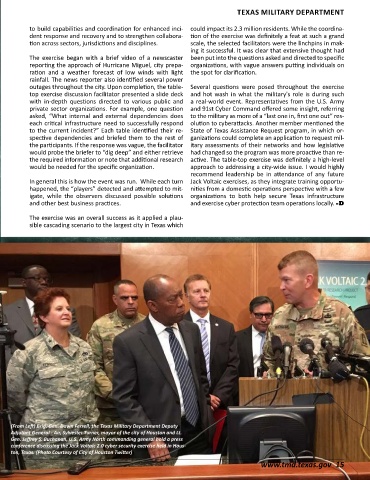
     (From Left) Brig. Gen. Dawn Ferrell, the Texas Military Department Deputy   General,(right) is joined by Sylvester Turner, Houston Mayor
     Adjutant General - Air, Sylvester Turner, mayor of the city of Houston and Lt.   (center) , and Brig Gen Dawn Ferrell, Texas Deputy Adjutant
     Gen. Jeffrey S. Buchanan, U.S. Army North commanding general hold a press   General - Air (left) addresses a crowd during the Jack Voltaic
     conference discussing the Jack Voltaic 2.0 cyber security exercise held in Hous-  2.0 cyber security exercise, (Photo Courtesy of Twitter)
     ton, Texas. (Photo Courtesy of City of Houston Twitter)

                                                                                       www.tmd.texas.gov 15

