


Page 18 - The Dispatch May 2019
P. 18
ALMOST LOST HOPE:


      THE JOURNEY FROM IRAQI TRANSLATOR TO TEXAS GUARDSMAN


                Story by Capt. Nadine Wiley De Moura
               Texas Joint Counter Drug Task Force

          AUSTIN, Texas— An old pot filled with water boils on an
          electric stove to be used for taking a warm shower, drink-
          ing or cooking. The government-run electric supply is limit-
          ed to five hours a day leaving people reliant on generators.
          The streets are littered with trash and sewage and some-
          times it’s unsafe to go outside due to chaos surrounding
          the regime.

          Centuries of war and corruption had led to failing infra-
          structure, and a people controlled by Saddam Hussein’s
          reign of terror, the daily reality for the people of Iraq was
          economic and emotional despair.

          For Baghdad native, Spc. Hussein Khairi, the poorly man-
          aged resources and living in a corrupt government were
          interwoven into his daily routine. Despite this, he studied
          passionately,  under  his  father’s  instruction,  learning  En-
          glish, not knowing that another war was ahead and his
          diligence in learning English would provide him the oppor-
          tunity to help change his country for the better.

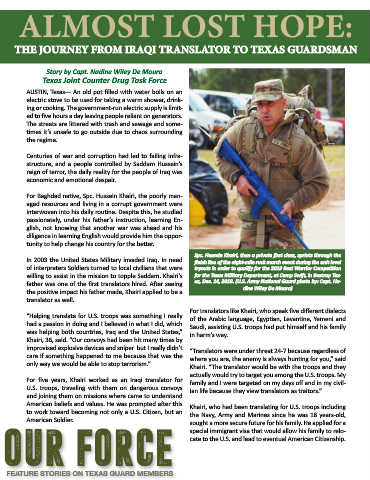
                                                                 Spc. Hussein Khairi, then a private first class, sprints through the
          In 2003 the United States Military invaded Iraq. In need   finish line of the eight-mile ruck march event during the unit level
          of interpreters Soldiers turned to local civilians that were   tryouts in order to qualify for the 2019 Best Warrior Competition
          willing to assist in the mission to topple Saddam. Khairi's   for the Texas Military Department, at Camp Swift, in Bastrop Tex-
          father was one of the first translators hired. After seeing   as, Dec. 14, 2018. (U.S. Army National Guard photo by: Capt. Na-
          the positive impact his father made, Khairi applied to be a            dine Wiley De Moura)
          translator as well.
                                                               For translators like Khairi, who speak five different dialects
          “Helping translate for U.S. troops was something I really   of the Arabic language, Egyptian, Levantine, Yemeni and
          had a passion in doing and I believed in what I did, which   Saudi, assisting U.S. troops had put himself and his family
          was helping both countries, Iraq and the United States,”   in harm’s way.
          Khairi, 36, said. “Our convoys had been hit many times by
          improvised explosive devices and sniper  but I really didn’t   “Translators were under threat 24-7 because regardless of
          care if something happened to me because that was the   where you are, the enemy is always hunting for you,” said
          only way we would be able to stop terrorism.”        Khairi. “The translator would be with the troops and they
                                                               actually would try to target you among the U.S. troops. My
          For  five  years,  Khairi  worked  as  an  Iraqi  translator  for   family and I were targeted on my days off and in my civil-
          U.S.  troops,  traveling  with  them  on  dangerous  convoys   ian life because they view translators as traitors.”
          and joining them on missions where came to understand
          American beliefs and values. He was prompted after this   Khairi, who had been translating for U.S. troops including
          to work toward becoming not only a U.S. Citizen, but an   the Navy, Army and Marines since he was 18 years-old,
          American Soldier.                                    sought a more secure future for his family. He applied for a
                                                               special immigrant visa that would allow his family to relo-
  OUR FORCE                                                    cate to the U.S. and lead to eventual American Citizenship.


   FEATURE STORIES ON TEXAS GUARD MEMBERS

